Mobile access towers can save you hours of time on projects at height. But a single structural failure or unexpected roll can put someone in the hospital. The safety features built into a tower aren’t optional extras; they’re what stands between a job done right and a serious incident. If you’re renting or buying a mobile access tower for the first time, knowing what to look for means you won’t end up with equipment that cuts corners where it matters most. Here’s what you should check before you commit.
A Stable, Locked Base with Outriggers
Before choosing any access tower, it is important to think about where the work will actually take place. Indoor jobs often come with tight spaces, finished floors, narrow doorways, and limited room for wide stabilising equipment, so the tower needs to match those conditions from the start. For example, MiTower Hire for indoor projects is created with a fixed, compact footprint that works indoors without traditional outriggers; it relies instead on a low centre of gravity for stability. The base is everything. It’s the foundation of everything that happens above it. For standard towers used outdoors, though, outriggers are non-negotiable. These extendable arms spread the load over a wider area and reduce the risk of tip-over under lateral forces, whether from wind, uneven ground, or a worker suddenly shifting their weight near the platform edge. Any tower you consider should have outriggers that lock firmly into place, not just rest or clip loosely. The locking mechanism should require deliberate release rather than a bump or accidental knock. Look at it yourself; push on it. The castors at the base should also have individual brakes that engage positively. If you press down on the brake lever and the wheel still rolls under moderate pressure, the brake is worn, and the equipment shouldn’t be in service; each caster needs its own rating for the combined load it’ll carry, and that rating should appear on the manufacturer’s specification sheet, not just on a label that can wear off.
Guardrails and Toe Boards That Meet OSHA Standards
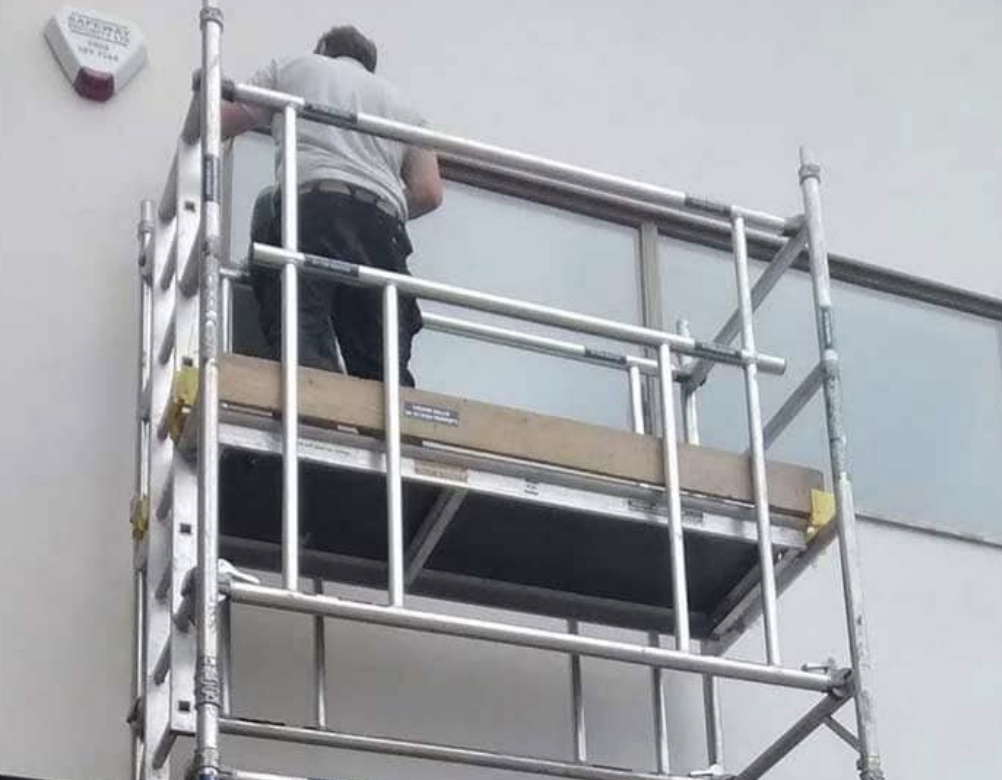
OSHA’s general industry standard at 29 CFR 1910.29 requires guardrail systems on work platforms to withstand at least 200 pounds of force applied in any downward or outward direction at the top rail. The top rail must sit between 39 and 45 inches above the walking surface. A mid-rail is required at roughly the midpoint between the top rail and the platform surface. These aren’t suggestions. Any mobile access tower rented or sold for commercial use in the US must meet these specifications. When you inspect a tower, apply light pressure to the guardrails yourself. They should feel solid. No flex, no wobble, no audible creaking, that’s what you’re after. Toe boards matter just as much. A toe board sits at the platform level and prevents tools, materials, or debris from rolling off the edge and falling on anyone working below. OSHA requires toe boards to be at least 3.5 inches high; even a small wrench falling from height can cause a serious head injury, so this feature is one that people frequently overlook and really shouldn’t.
A Trapdoor or Through-the-Trap Access Hatch
How you get onto the platform matters as much as the platform itself. Some older or cheaper tower designs use an external ladder attached to the outside frame, which means a worker climbs up fully exposed on the outside of the structure. Modern towers built to current safety standards use an internal through-the-trap or stairway tower system instead; the worker climbs inside the frame and steps up through a trapdoor hatch on the platform deck. This keeps the climber within the tower’s footprint the whole time, so their weight doesn’t pull the tower outward. The trapdoor itself needs a spring-loaded or counterweighted hinge that holds the hatch open while the worker climbs through, then closes flush once they’re on the platform. A hatch that can slam shut on a worker’s hands, or one that stays propped open as a trip hazard, defeats the purpose entirely. Check the hinge mechanism before use. It should open smoothly and hold its position under the weight of the access cover; when you release it, it should return to the closed position cleanly, without excessive force.
Load Ratings Clearly Marked on the Platform Deck
Every mobile access tower has a safe working load (SWL), and that number must account for the combined weight of workers, tools, and materials on the platform at any one time. In the US, scaffolding regulations under OSHA 29 CFR 1926.451 require that scaffolds support at least four times the maximum intended load. The SWL should be stamped, engraved, or permanently labelled on the platform deck itself, not just listed in a manual that might not be on site. Look for a platform that clearly states its load capacity in pounds. Light-duty towers carry 250 pounds; medium-duty models handle 500 pounds; heavy-duty platforms support 750 pounds or more. If the platform deck shows no visible rating, treat it as non-compliant and don’t use it until you get written confirmation of the capacity from the manufacturer or hire company. Overloading a platform doesn’t just risk the surface collapsing; it changes the tower’s centre of gravity and dramatically increases tip-over risk, particularly if the load is unevenly distributed near one edge.
Interlocking Frame Components and Anti-Collapse Bracing
A mobile access tower is only as safe as its frame connections. Frames that rely solely on friction fits or push-together connections without positive locking can separate under vibration or lateral load; a partial or full collapse can follow with no warning. Look for towers whose horizontal and diagonal brace sections click or pin into place with an audible or tactile confirmation. Many quality towers use spring-loaded locking pins or integral latch buttons that must be deliberately depressed before a brace can be removed. This type of interlocking system means a section can’t work loose during normal use. Diagonal braces are particularly important; they prevent the tower from racking, which is the sideways deformation that happens under lateral load. A tower with insufficient diagonal bracing can lean several inches before anyone notices, and by that point, the structure’s geometry is already compromised. Ask the manufacturer or the hire company for the assembly instructions before you rent. If the documentation doesn’t call for diagonals on every bay or doesn’t clearly specify where they go, that’s a red flag.
Conclusion
Checking what safety features you need in a mobile access tower before you rent or buy is one of the most practical things you can do to protect yourself and anyone else working on site. A locked base, code-compliant guardrails, through-trap access, clear load ratings, and interlocking frame components address real failure modes documented in OSHA incident data. Don’t let price alone determine the decision; a tower that saves you $50 on the rental but lacks a positive caster brake or proper guardrail height isn’t a bargain.
Originally published by UKNIP.